
Starship Flight 15 Explained: First Upper-Stage Catch After Orbit
SpaceX's Starship Flight 15 flew 22 hours, deployed 26 satellites and was caught by the launch tower. What happened, why it matters and science content ideas.
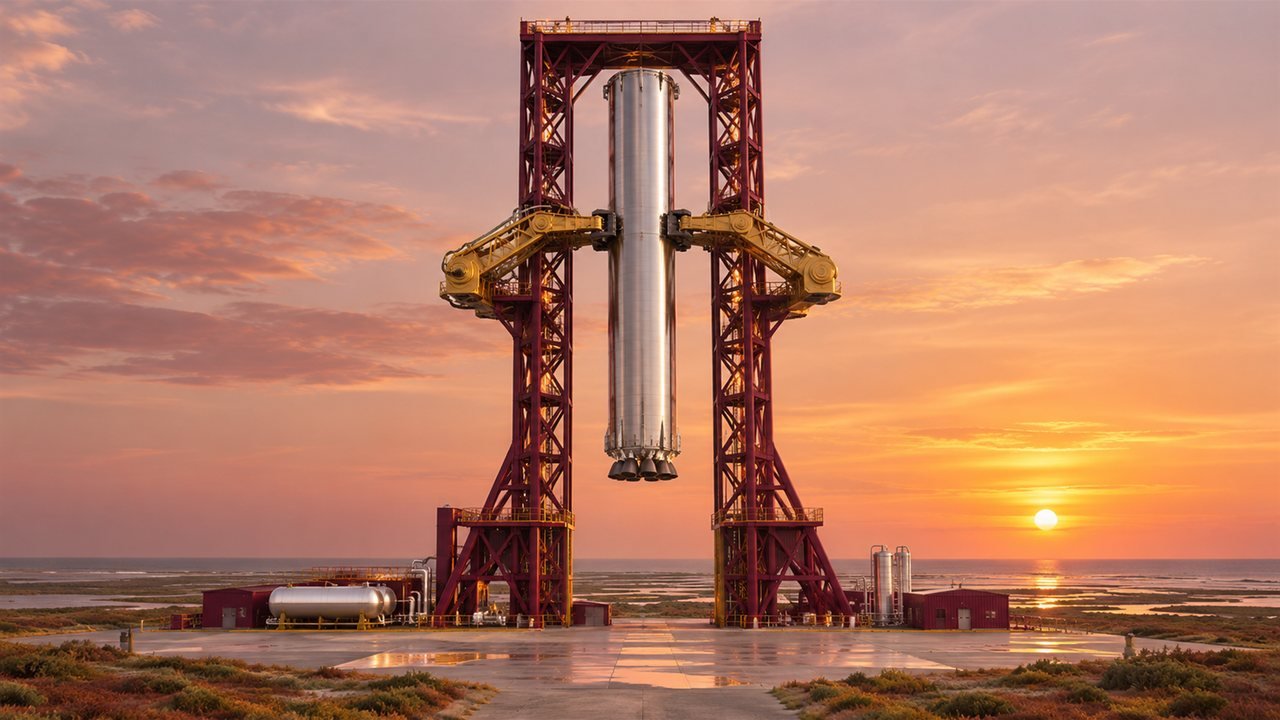
Space fans had a big week. SpaceX's Starship Flight 15 spent about 22 hours in space and then, according to reports, its upper stage was caught by the arms of the launch tower in Texas. This post explains what happened in simple terms and gives creators ideas for making science content that people actually finish watching.
What happened on Starship Flight 15
Starship is SpaceX's giant two-part rocket: a Super Heavy booster at the bottom and the Starship "ship" (the upper stage) on top. Both are designed to be reused.
- Launch: 13 November 2026, 5:47 p.m. US Eastern time, from Starbase, Texas
- Vehicles: Booster 22 and Ship 42, both from the newer "Block 3" generation (SpaceX calls the booster version V3)
- Power: the booster's 33 Raptor 3 engines produced more than 18 million pounds of thrust
The ship: a long flight and a first
- The ship reached low Earth orbit, about 275 km up, roughly 26 minutes after launch.
- It deployed 26 Starlink V3 satellites over about 42 minutes. Three of them carried cameras to photograph the ship's heat shield.
- It circled Earth about 14 times over roughly 22.5 hours, the longest Starship flight so far.
- On 14 November, it returned to Starbase and was caught by the tower's arms, according to Wikipedia's mission page and Space.com's photo coverage. Wikipedia describes it as the first successful upright landing of a rocket upper stage after reaching orbit.
The booster: a planned catch called off
SpaceX had hoped for a "double catch" (both stages caught by the tower). The booster completed its return burn, but its automatic safety checks called off the catch, and it was diverted to a splashdown in the Gulf of Mexico. Elon Musk said the engines had slightly underperformed, leaving too little fuel for a catch, and that the loss would not change the timeline for fully reusable flights.
Why it matters
- Reusability is the whole point. Catching rockets instead of throwing them away is how launches get cheaper. Catching the upper stage after orbit is a step that had never been done before.
- Bigger satellites, faster internet. SpaceX says this single batch of V3 Starlink satellites adds about a terabit of capacity, roughly the same as ten launches of the older satellites on Falcon 9.
- What comes next. Flight 16 is expected to be the first Starship launch from Launch Complex 39A in Florida, according to Wikipedia.
- The Moon. Starship is part of NASA's plans for future Artemis Moon missions, so every test is watched closely.
Why it is trending
- The visuals. A skyscraper-sized rocket being caught by giant metal arms is one of the most shareable images in science.
- Mixed results make debate. One stage caught, one stage lost: perfect for "success or failure?" discussions.
- Livestreams. SpaceX streams every flight, so millions watch together in real time.
5 content ideas for science and tech creators
- "Why catch a rocket?" in 60 seconds. Use a simple analogy: throwing away a plane after every flight versus landing and refuelling it.
- Paper or 3D-printed model. Show the two stages with a model and explain which part does what. Hands-on content holds attention. Our short video script framework helps you structure it.
- "How big is Starship?" comparison. Compare its height with local landmarks your audience knows. For Indonesian viewers, compare with a familiar tall building.
- Kids' science explainer. Space is a top topic for families. Use calm visuals and simple words, and pair it with the critical-thinking habits from our family AI literacy guide.
- Timeline carousel. Flights 1 to 15 in one swipe, with one milestone each. Check each fact against the official SpaceX updates or a reliable space outlet.
How to report space news accurately
- Separate goals from results. "SpaceX planned to catch both stages" is different from "SpaceX caught both stages."
- Use official sources for numbers (SpaceX, NASA) and reputable space outlets like Space.com. Our AI research and fact-checking workflow shows how to verify fast.
- Update your post if new details come out. Space missions often have corrections in the days after.
- Do not use dramatic words for failures. Test flights are designed to find problems. "The booster did not complete its catch" is more accurate than "explosion disaster."
Key takeaways
- Starship Flight 15 launched on 13 November 2026 and flew about 22.5 hours, the longest Starship flight so far.
- The ship deployed 26 Starlink V3 satellites and was caught by the launch tower on 14 November.
- The booster's planned catch was called off, and it splashed down in the Gulf of Mexico.
- Rocket catches are about reusability, which makes spaceflight cheaper; great topic for clear, visual explainers.
Sources
Read next
 NEW
2027 Grammy Nominations: RAYE Leads, JENNIE Gets Her First Nods
RAYE leads the 2027 Grammy nominations with 11, Rosalía has nine and JENNIE got her first nods. The key lists, the stories and content ideas.
Read more
 NEW
GTA 6 Launch Week: Records, Reviews and What's Confirmed
The GTA 6 launch on 19 November brought a 99 Metacritic score and record sales estimates. What is confirmed, what is estimated, and what it means for creators.
Read more
 NEW
GTA VI Launch in Indonesia: Windah's Live Record and Viral Memes
The GTA VI launch on 19 November 2026 gave Indonesian YouTuber Windah Basudara a record of nearly 400,000 live viewers. What happened and what creators learn.
Read more